

AI in the Executive Office: How Microsoft Copilot Combines Governance and Efficiency
Executive Summary
Artificial intelligence (AI) is entering the world of corporate leadership, promising greater efficiency through automated meeting minutes and intelligent decision support. To harness these benefits safely, clear governance and compliance structures are essential. AI is thus evolving from a technical tool into a strategic co-pilot of modern corporate management.
Introduction
The discussion around AI in corporate leadership is gaining momentum. Tools like Microsoft Copilot promise greater efficiency through automatic note-taking, intelligent summaries, and faster decision-making processes.
Recent data underscores this trend: according to the McKinsey Global AI Survey 2025, more than three-quarters of surveyed companies already use AI in at least one business area. At the same time, the study highlights significant challenges regarding governance, cybersecurity, and data protection (McKinsey, 2025). For sensitive areas such as board operations, these findings have far-reaching implications.
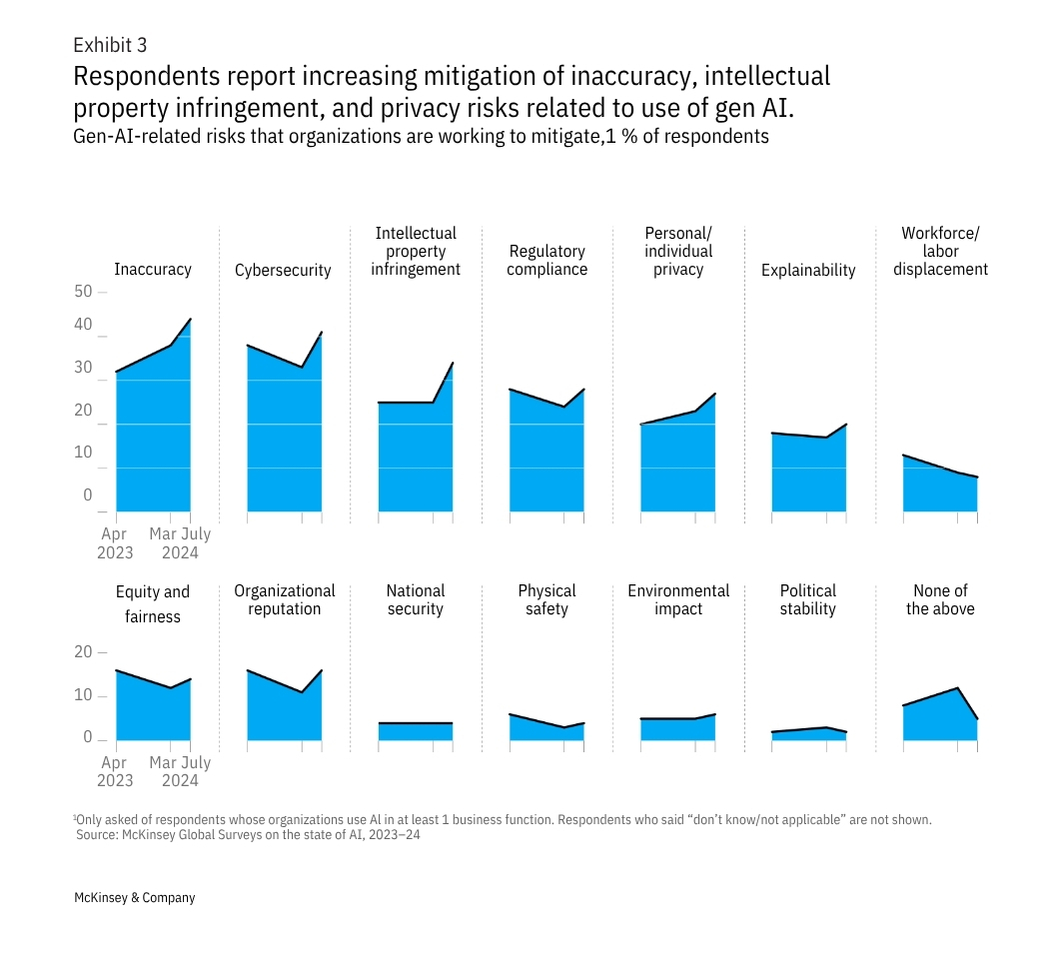
Fig. 1: Companies identify inaccuracy, cybersecurity, and data protection as the main risks when using generative AI (McKinsey Global AI Survey, 2025).
Academic research also emphasizes that while AI offers major efficiency potential in corporate governance, these benefits can only be sustained if clear organizational and regulatory frameworks are in place. Without such structures, companies risk losing transparency, accountability, and liability control (Agnese, Arduino & Di Prisco, 2025).
Why Compliance Matters in AI Implementation
The key question is no longer whether AI should be used, but how it can be safely embedded into existing governance frameworks. Especially in executive environments, where highly sensitive information is processed, compliance requirements must take top priority.
From a technical perspective, the main risks stem from:
• Server locations outside the EU (for example, in the US) where different data protection standards apply
• Machine-learning models trained on data not originally intended for that purpose
• Lack of access control in generative models when rules for input and data storage are unclear
Without secure infrastructure, AI can inadvertently lead to data leaks or opacity. Governance, therefore, requires the creation of technical and organizational frameworks that make AI deployment transparent and controllable. This is particularly important for organizations using Microsoft 365 or board-management software that integrates AI tools such as Microsoft Copilot.
Typical questions raised by executives and their assistants include:
• Are confidential data protected?
• How can traceability be ensured?
• Where are the limits of AI, and where does human oversight remain essential?
Governance as the Foundation for Responsible AI Use
The German Corporate Governance Code Commission (2025) emphasizes that supervisory boards must define clear boundaries for AI usage. Only then can risks be managed and accountability clearly assigned.
AI is therefore not only about efficiency but also about responsible leadership—a true test of modern corporate governance. Especially within executive offices, technology can only be effective when supported by structured, transparent, and compliant processes. Trust in AI depends on secure foundations, not blind adoption.
This is where Boardwise and PHAT CONSULTING come in, providing both the technical and organizational groundwork for responsibly integrating AI into board operations.
A Secure Foundation for AI Integration: Boardwise & PHAT CONSULTING
Before AI can be meaningfully integrated, organizations need a stable digital foundation—particularly for digital board operations and the use of Microsoft Copilot. Boardwise and PHAT CONSULTING have partnered to establish exactly this framework, driven by one goal: combining efficiency with security.
Boardwise consolidates all key board processes on a centralized, Microsoft 365-based platform:
• Agenda management with drag & drop—flexible, compliant, and centrally managed
• Automated scheduling and calendar synchronization—no manual follow-up required
• Digital minute-taking and resolution tracking—audit-proof and transparent
• Centralized documentation—all materials stored securely in one place, not scattered across emails or SharePoint
Transparency and control create the foundation on which AI solutions like Microsoft Copilot can be safely embedded.
🎯 Experience Boardwise live:
In a short product demo, we’ll show how meeting organization, decision tracking, and documentation come together on one Microsoft 365-integrated platform—forming the foundation for secure AI usage.👉 Request a Boardwise demo now and discover how Microsoft Copilot can be safely integrated.
PHAT CONSULTING complements this with technical and regulatory expertise to ensure secure AI deployment in regulated environments. As a Microsoft Gold Partner, the team supports organizations in three key areas:
• Technical security: Copilot is configured so that sensitive data remain entirely within the company’s infrastructure.
• Compliance consulting: Regulatory and corporate governance requirements are built into every implementation.
• Practical onboarding: Executives and assistants receive hands-on guidance during their transition to AI-supported workflows.
Microsoft Copilot: AI as a Co-Pilot, Not a Risk
With this foundation in place, Microsoft Copilot can reach its full potential:
• Automatic summaries of complex documents
• AI-assisted analytics for decision-making
• Intelligent minutes and task tracking
The true value emerges when Copilot operates within a secure process landscape. In this context, AI becomes not a risk but a catalyst for efficiency and transparency.
Satya Nadella, Microsoft’s CEO, describes this role succinctly:
“I see these technologies acting as a co-pilot, helping people do more with less.” (Lin, 2023)
Conclusion: Efficiency and Security Go Hand in Hand
AI in corporate leadership is already a reality. Whether it generates value or mistrust depends entirely on how it is integrated. Especially in sensitive environments such as executive and supervisory boards, a secure Microsoft 365 integration forms the basis for responsible AI adoption.
If Copilot is deployed without preparation, uncertainty and resistance will follow. But when embedded into well-defined structures, it realizes its full potential—as a reliable co-pilot for modern board operations.
How can organizations balance efficiency and compliance in practice?
🎯 Discover Boardwise:
In a concise live demo, we’ll show how meeting organization, decision tracking, and documentation seamlessly connect on a Microsoft 365-based platform—creating the foundation for secure AI use.
👉 Request your demo now and learn more about integrating Microsoft Copilot safely.


