

Expert Interview with Silke Nevermann: Why Technology Alone Cannot Create Transformation
The Blind Spot of Many AI Initiatives
Artificial intelligence is on everyone's lips and is currently changing at breakneck speed the way organizations process knowledge, prepare decisions, and structure work methods.
At the same time, companies are investing massively in digital platforms, governance structures, and new forms of collaborative decision-making – always with the expectation of making work methods more efficient, transparent, and future-proof.
In many places, however, the claim to progress gives way to a certain disillusionment: Although organizations today have access to more powerful technologies than ever before, transformation projects continue to fail surprisingly often.
How can this paradox be explained?
Transformation is not determined solely by the performance of a technology, but by how organizations culturally pave the way for change.
In our conversation with Silke Nevermann, we explored precisely this tension between humans and technology.
Nevermann is the founder of Office Concepts, a Change Management Coach, and an expert in modern collaboration. She supports companies in making digital transformation effective not only technologically, but especially culturally. Her focus is on AI in everyday work, hybrid collaboration, virtual collaboration, and the question of how change can be sustainably accepted and anchored in organizations. She combines technological competence with years of experience in communication, transformation, and leadership proximity.
Why Many Transformations Fail from the Start
For many companies, transformation is still primarily considered an implementation task. Systems are selected, processes defined, and responsibilities distributed. Communication of corresponding measures often only begins when decisions have long been made organizationally and the actual implementation is imminent. For Nevermann, this is precisely one of the central conceptual errors of modern change initiatives:
"Dialogue does not begin only with the rollout of a tool."
From an organizational perspective, change may appear rational. For employees within this organization, however, it often initially means the loss of existing orientation. Routines that have created stability and security of action over years are questioned, while at the same time it remains unclear which rules will apply in the future. When this order is changed, transformation affects not only processes, but always also the cultural architecture of an organization.
"Transformation does not just mean introducing new tools. You change existing work logics."
The ADKAR model from Change Management therefore describes successful transformation as a step-by-step process: People must first understand why change is necessary, gain orientation in dealing with new work methods, and finally be able to apply them safely in everyday life. It is precisely between Awareness and Knowledge that the uncertainty often arises that initially slows down change.

Communication is often underestimated by organizations as a lever. In fact, however, it determines whether change becomes tangible and connectable at all.
Many employees today experience transformations as a sequence of ever-new initiatives, often accompanied by the feeling: "Yet another change project." If it is not clearly communicated why work methods are changing specifically and what orientation remains, distance rather than participation quickly emerges.
Based on her empirical values, Nevermann also advocates for a different view of the resistance that organizations encounter in change processes.
"You often learn the most from skeptics."
In her experience, resistance rarely stems from fundamental innovation rejection. Often, it makes visible where organizations have failed to make connections understandable: What are the concrete consequences? What responsibility remains with humans? What risks arise? And how does one's own role change within new technological structures?
Between AI Breakthrough and Disorientation
This dynamic is particularly evident in the topic of Artificial Intelligence: Hardly any technological development currently generates so much strategic expectation and diffuse uncertainty simultaneously.
Companies discuss productivity gains and efficiency potential, while many employees still cannot clearly assess what use is legitimate, what risks exist, or how visible AI support may be in everyday work.
In an AI bootcamp that Silke Nevermann led at a large industrial company, precisely this tension became immediately tangible. At the beginning, employees were dominated by restraint, data protection concerns, and distance toward the technology.
"Many had the feeling: I don't know about this, so I'd rather leave it alone," Nevermann recalls.
The restraint did not arise primarily from technological rejection, but from lack of orientation. As soon as it remains unclear which rules apply or which use is accepted within the organization, the feeling of potentially acting incorrectly quickly emerges.
"When I don't know which documents I may use or which rules apply, uncertainty automatically arises."
All the more remarkable was the speed with which this attitude could be reversed – simply through education about what possibilities AI concretely opens up, what limits must be observed, and what rules apply for safe use in everyday work.
"The jump from 'I don't use that at all' to 'I use that daily' was enormous," Nevermann recalls.
The technological conditions had not changed, but the degree of orientation had:
"As soon as people have orientation, courage also emerges."
The Silent Shift of Expertise and Authority: What Changes for Decision Makers
Nevermann illuminates another shift in our conversation: AI no longer only changes operational routines, but increasingly intervenes in those areas that have long been considered the core of human expertise. These include analysis, structuring, prioritization, and preparation of complex decisions.
Technology thus implicitly also affects existing decision-making and responsibility structures:
"When AI intervenes more strongly in decision-making processes, many executives feel a sense of loss of significance."
This uncertainty remains largely unspoken in many organizations, but nevertheless shapes the handling of technology.
The Tabooization of AI Use
This uncertainty remains largely unspoken in many organizations, but nevertheless shapes the handling of technology.
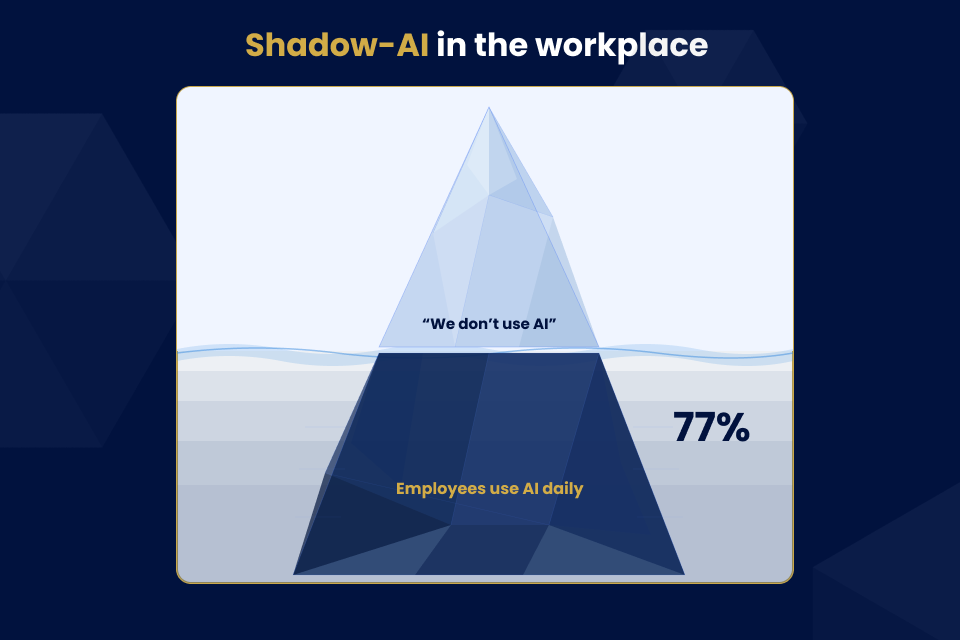
In parallel, a cultural contradiction emerges: Many employees have long been using AI productively in everyday life, but hardly speak openly about it. In many organizations, there still exists the implicit notion that "good work" is primarily legitimized through manual performance and AI support seems more like a shortcut than professional competence.
How widespread this covert use already is is also shown by a YouGov study commissioned by SThree from 2025: 77% of STEM professionals in Germany use AI tools at work, and a similarly high proportion regularly uses unauthorized applications. The use is therefore already taking place, but often outside clear organizational orientation and governance structures (dpa, 2025).
Nevermann therefore advocates for a more differentiated perspective on AI use. In the future, what will be decisive is less the mere operation of technologies than the ability to reflectively classify their use – entirely in the spirit of the "Human in the Loop" approach:
"A bad standard answer remains a bad standard answer, even if it was formulated by AI," she puts it succinctly.
AI does not replace judgment, but rather increases the need to use it consciously.
Why Good Governance Emerges Long Before the Meeting
How can governance and decision-making processes be designed more efficiently from Nevermann's perspective?
When organizations talk about better decisions, attention is often focused on the actual meeting. For Nevermann, decision quality begins much earlier: where information is prepared, structured, and made accessible.
This involves not only those who create decision bases, but also the responsibility of the decision makers themselves. Especially in board and management contexts, however, there is often insufficient time to work through complex and fragmented information statuses.
Historically grown decision-making processes often create considerable friction losses: short-term changes, parallel document versions, and high manual coordination effort make not only efficiency difficult, but also transparency and traceability.
Digital systems can reduce this complexity, but only if they do not create new complexity themselves.
"It is not enough to simply digitize everything. The advantage of new digital processes must be visible and intuitively experienceable," she states.
Many digital solutions fail precisely at this point in her view: They create new functions, but generate additional friction in everyday life – for example through complicated access, fragmented interfaces, or lack of clarity.
What is decisive is therefore not the mere digitization of a process, but the question of whether a system actually creates orientation and meaningfully relieves participants.
Only then can technology achieve more than pure efficiency improvement and become the foundation for better decision quality.
The Underestimated Challenge of the Coming Years
The conversation with Silke Nevermann makes clear that many organizations still misclassify the central challenge of digital transformation.
The decisive difference will lie less in who has access to the best technologies, but rather in which organizations are culturally capable of keeping pace with this speed.
"Transformation needs communication." This thought ran like a leitmotif through the entire conversation.
What is decisive is communication long before change has already been decided: where people understand why work methods are changing and what role they themselves play in it.
Technology changes processes – communication, orientation, and responsible involvement determine whether sustainable transformation emerges from this.
Sources:
Prosci. (n.d.). The Prosci ADKAR® model. https://www.prosci.com/methodology/adkar
dpa. (2025, November 21). Work Environment and AI: "Shadow IT": Many Professionals Use AI Without Permission. DIE ZEIT. https://www.zeit.de/news/2025-11/21/schatten-it-viele-fachkraefte-nutzen-ki-ohne-erlaubnis


